Visitors interested in Schindler’s Factory often ask what other places in Kraków help explain the wartime reality behind the stories told inside the museum. The answer lies in the city’s Memory Trail – a thematic route connecting key locations linked to the German occupation, the Kraków Ghetto, forced labour, repression, and post-war remembrance.
Rather than focusing on a single site, the Memory Trail places Schindler’s Factory within a broader urban and historical context, showing how occupation policies shaped everyday life across different parts of the city. Together, these places reveal how rescue, survival, and terror existed side by side in wartime Kraków.
What Is the Memory Trail?
The Memory Trail is a conceptual walking route curated by Kraków’s municipal museums. It links sites connected with the years 1939–1945 and the immediate post-war period, when the city transitioned from Nazi occupation to communist rule. The route highlights key processes: segregation, forced labour, deportations, resistance, and the long-term work of memory.
For visitors primarily interested in Schindler’s story, the trail offers essential background. It explains how the Kraków Ghetto functioned, where Schindler’s workers came from, and what happened to those who were not protected. Most visitors need four to five hours to see the core sites, with a full day recommended if the former Płaszów camp is included.
Ghetto Heroes Square – The Centre of the Kraków Ghetto
At the heart of the former Kraków Ghetto lies Ghetto Heroes Square, once known as Zgody Square. Between 1941 and 1943, this space served as the central assembly point of the sealed district. Deportations, selections, and forced gatherings took place here under German supervision.
Today, the square is defined by a memorial of empty metal chairs, unveiled in 2005. Their simple form symbolises absence – the people who waited here and were deported or murdered during the liquidation of the ghetto. For visitors leaving Schindler’s Factory Museum, the square provides a powerful visual link between historical narrative and physical space.
The creation and function of ghettos such as Kraków’s followed patterns imposed across occupied Europe, as documented in studies of Nazi ghettos.

Pharmacy Under the Eagle – Help Inside the Ghetto
Directly on Ghetto Heroes Square stands the Pharmacy Under the Eagle, the only pharmacy allowed to operate inside the Kraków Ghetto. Run by Polish pharmacist Tadeusz Pankiewicz, it became a place of assistance, shelter, and discreet resistance.
Beyond dispensing medicine, the pharmacy offered hiding places during round-ups, smuggled food and information, and served as a communication point between the ghetto and the outside world. Pankiewicz later described these experiences in his memoir The Kraków Ghetto Pharmacy, one of the most important eyewitness accounts of life inside the ghetto.
For visitors interested in expanding their understanding beyond Schindler’s Factory, the history of the Pharmacy Under the Eagle provides crucial insight into everyday moral choices made under occupation.
Schindler’s Factory – Occupation and Rescue in Context
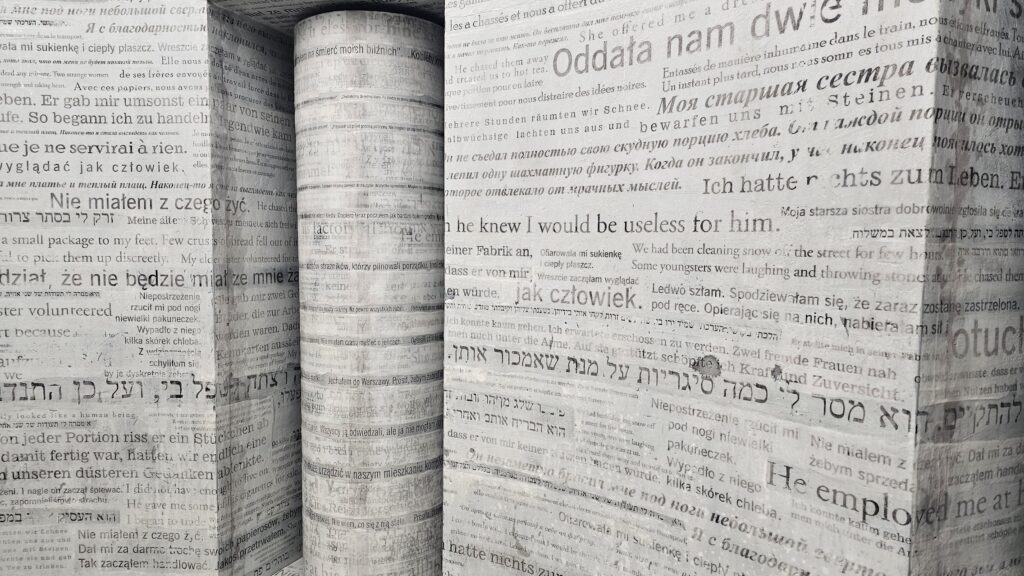
A short distance away, Schindler’s former enamelware factory houses the permanent exhibition Kraków Under Nazi Occupation 1939–1945. The museum presents daily life under German rule: repression, propaganda, forced labour, and resistance, placing the rescue of Jewish workers within a wider historical framework.
Understanding the history of Schindler’s Factory in Kraków helps explain how the factory functioned as part of the German war economy while simultaneously becoming a site of protection for approximately 1,200 people. The Memory Trail reinforces that this rescue did not occur in isolation, but within a city shaped by systematic violence and fear.
KL Płaszów – From Ghetto to Camp
South of Podgórze lies the former KL Płaszów, established in 1942 as a forced-labour camp and later transformed into a concentration camp. After the liquidation of the Kraków Ghetto in March 1943, thousands of its former residents were deported here.
Today, Płaszów remains largely an open landscape rather than a traditional museum. Paths, execution sites, and memorials mark a terrain where absence itself has become part of remembrance. Many people saved by Schindler narrowly avoided deportation to this camp, making Płaszów a key reference point for understanding the stakes of rescue.
Pomorska Street – Terror Under Two Regimes
Another important stop on the Memory Trail is Pomorska Street 2, which served as the Gestapo headquarters during the occupation. Interrogations, imprisonment, and torture took place in its basement cells.
After 1945, the building was taken over by the communist security services, making it a rare site documenting repression under two totalitarian systems. Its exhibition focuses on the experiences of civilians, members of the underground, and prisoners whose lives were shaped by both regimes.
Planning a Visit Along the Memory Trail
For visitors whose main destination is Schindler’s Factory, the Memory Trail offers a natural extension rather than a separate itinerary. A commonly followed route links Pomorska Street, Ghetto Heroes Square, the Pharmacy Under the Eagle, and Schindler’s Factory, with the option to continue to the Płaszów Memorial Site.
Practical guidance on timing, tickets, and logistics is available when you plan your visit, allowing enough time not only to move between sites but also to pause and reflect.
Why the Memory Trail Matters
The Memory Trail shows how Schindler’s actions fit into the wider history of Kraków under German occupation. It connects rescue with persecution, individual choices with systemic violence, and museum exhibitions with the real streets and squares where history unfolded.
For anyone seeking to understand Schindler’s Factory more deeply, the trail offers essential context – grounding one extraordinary story in the broader reality of wartime Kraków, its communities, and the enduring processes of remembrance that continue to shape the city today.
Leave a Reply